📊 Today's Overview
| Domain | Items | Top Score | Headline |
|---|---|---|---|
| 🤖 AI Domain | 6 | 70.75 | First physical-space Agent OS lets AI take over smart homes. |
| 💻 Technology | 2 | 67.6 | NGINX Gateway Fabric production-ready; rate limiting and GPU routing become key. |
| ⚙️ Software Engineering | 3 | 70.75 | Claude-driven fully automated software factory, directly connected to GitHub. |
🤖 AI Domain
📌 First physical-space Agent OS lets AI take over smart homes.
★★★★☆ 70.75 | Source: V2EX - Technology
This is not just another smart home platform—it's a fundamental restructuring of the Agent-physical world interaction paradigm. The author keenly points out that the essence of current smart homes remains "remote control," while true intelligence requires Agents to become "natives" of physical spaces.
The core value for developers lies in its hardcore architecture design:
- Spatial Topology (SSSU) replaces device-centric models with 2x2 meter grids, solving multi-Agent swarm intelligence conflicts at the architecture level.
- Physical Fuse hard-codes the "Three Laws of Robotics" from science fiction into the OS—a critical step for safely introducing AI into the physical world, addressing enterprise deployment concerns.
- Spatiotemporal Holographic Memory provides Agents with four-dimensional causal memory, the foundation for advanced reasoning.
Action Item: If you're working on smart home, robotics, or IoT projects, don't miss this project. Its "spatial grid" and "safety fuse" concepts may become standard architecture for next-generation physical-space applications. Study the implementation of s2-os-core on GitHub, and watch how it unifies heterogeneous devices from HA / Mi Home / Tuya.
📌 "Shrimp farming" becomes new research paradigm; AI4S implementation guide released.
★★★★☆ 70.75 | Source: OSChina - All - 白开水不加糖

This marks the "Lobster" Agent evolving from a geek meme into a research productivity tool. The livestream's core value lies in clearly defining the differences between DrClaw and the general OpenClaw—optimized specifically for research scenarios, emphasizing data security, toolchain automation, and collaborative scheduling.
For Chinese research developers, this provides a clear AI4S implementation roadmap:
- Toolchain Integration: Full-process demonstration from local deployment to data processing and tool orchestration lowers the entry barrier for research teams.
- Multi-Agent Collaboration: The platform design of "one query triggering multiple agents" showcases how to build an "expert team" model for solving complex research problems.
- Community Ecosystem: The Aisaith community aims to service-ize distributed computing power, models, and agents—aligning with domestic trends toward localized and platform-based research infrastructure.
Action Item: Researchers should focus on DrClaw's applications in project assistance and automated data processing. Join the community to access replays and resources, and evaluate how to integrate it into existing workflows or develop discipline-specific Agents based on its framework.
📌 Anthropic reveals: Why would the most advanced AI orchestration system "self-sabotage"?
★★★★☆ 70.75 | Source: WeChat Forwarder - Telegram Channel

This article reveals a profound contradiction in AI engineering: the stronger the model capabilities, the thinner the orchestration layer may become. Anthropic built a complex Harness (control system) for Claude to handle long-duration, full-stack development tasks, yet actively thins it out, pursuing "the thinnest wrapper layer."
This reflects a clash of two philosophies:
- "Thick Harness" camp: Believes complex orchestration, memory, and tool invocation systems are needed to drive models.
- "Thin Harness" camp (like the Claude Code team): Believes the secret weapon lies in the model itself; the wrapper layer should be minimal.
Anthropic's "self-sabotage" practice suggests they're validating the "model-first, orchestration-simplified" approach. This is an important signal for developers: when building Agent applications, don't over-engineer complex control flows—first explore the model's native instruction-following and reasoning capabilities. As models iterate, many middleware layers may become redundant.
Action Item: Re-examine your Agent architecture. Can those complex memory retrieval and task decomposition modules be replaced by stronger models' native capabilities? Keeping architecture "thin" and "deletable" may be the best strategy for adapting to rapid model iteration.
📌 Claude Dispatch precisely targets OpenClaw; Apps aren't dead—they're becoming AI command consoles.
★★★★☆ 70.75 | Source: 36Kr - 24h Hot List
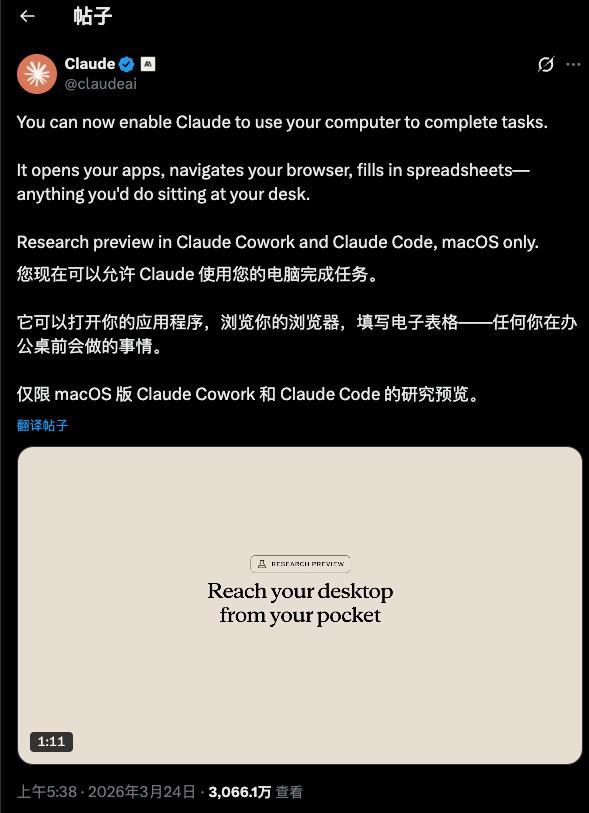
This is a textbook case of "supplier becoming competitor." Anthropic provides the brain for OpenClaw while simultaneously releasing Dispatch and other features that precisely target its core capabilities, using security and compliance as entry points for a dimensionality-reduction strike.
The deeper insight refutes the "App is dead" narrative. Anthropic's product logic demonstrates:
- Natural language bandwidth is insufficient: Complex instructions are easy to issue, but intermediate confirmations and result reviews still require GUIs.
- Trust needs anchors: Like a steering wheel in autonomous driving, Apps will become control panels for humans to intervene and supervise AI.
- Apps enter their third lifecycle: Evolving from function containers and content consumption terminals to AI command consoles.
Action Item: Developers should not blindly follow the "no-interface" narrative. Start thinking immediately: how can your App become an AI-friendly interface? For example, design clear APIs for Agent calls, optimize visual information density for AI to relay results, and add human confirmation mechanisms at critical nodes. This is key to App survival and value creation in the AI era.
📌 Alibaba Cloud "Lobster" opens for free; AI assistant deployment enters zero-barrier era.
★★★☆☆ 67.6 | Source: OSChina - All - 白开水不加糖

The full opening of Alibaba Cloud JVS Claw marks a key step in "shrimp farming" expanding from geek circles to the general public. The strategy is clear: use cloud one-click deployment to solve local operations pain points, and use ecosystem binding (WeChat, Weibo assistants) to lower usage barriers.
This reflects how domestic AI platform competition has shifted from model capabilities to experience and ecosystem:
- Zero-barrier deployment: No invite codes, no local environment needed—just download the client, solving OpenClaw's biggest entry obstacle.
- Multi-platform integration: Voice input, Skill toggles, and scheduled tasks all aim to seamlessly embed Agents into daily toolchains.
- Points for engagement: "Shrimp farming diaries" and other operational activities build user habits.
Action Item: For users who want to try AI personal assistants but fear technical complexity, now is the time to get started. Visit the official site to download and experience it. For industry observers, note the differences between JVS Claw and OpenClaw / Claude Dispatch in security models, control ownership, and data privacy—these will be core to the next phase of competition.
📌 Lingke Cloud simplifies "Lobster" WeChat integration; cloud deployment becomes mainstream choice.
★★★☆☆ 66.25 | Source: OSChina - All - 零克云
This article is essentially a promotional tutorial for Lingke Cloud's "cloud Lobster" service, but it clearly compares the pros and cons of local deployment versus cloud hosting. For most enterprise users and individuals, cloud hosting has overwhelming advantages in deployment speed, operations costs, and security.
Key information:
- Official WeChat support: WeChat launched **Cl
💻 Technology
📌 NGINX Gateway Fabric production-ready; rate limiting and GPU routing become key.
★★★☆☆ 67.6 | Source: OSChina - All - 白开水不加糖
This update gives NGINX Gateway Fabric true production-grade capabilities. Most notably, its new features directly address core pain points in AI infrastructure.
Key insights:
- Rate limiting as cost control: GPU resources are expensive and inelastic. Rate limiting inference requests directly relates to protecting compute investments and ensuring fair allocation.
- Session affinity reduces compute waste: For long-context AI conversations, session affinity avoids reloading model context in each instance, significantly saving GPU compute cycles.
- Unified traffic entry: With support for TCP/UDP routing and Gateway API Inference Extension, model inference, vector databases, and traditional application traffic can be managed uniformly, simplifying architecture.
Action Item: Ops and MLOps engineers deploying AI inference services should evaluate this version. Use its rate limiting, session affinity, and multi-inference-pool routing capabilities to build an AI traffic gateway that both protects GPU investments and ensures service stability. This is better suited for the AI era than traditional Ingress Controllers.
📌 Wildfire IM updates, expanding IoT and wearable device scenarios.
★★★☆☆ 66.25 | Source: OSChina - All - Gitee Briefs
While this update lacks explosive features, it reveals an evolution direction for IM systems: becoming the communication hub connecting all things. New support for cloud storage, wearable devices, and TV devices means IM systems are breaking beyond traditional "person-to-person communication."
The underlying technical consideration is the generalization of communication protocols and clients:
- Server-side needs to handle more complex message types and storage requirements.
- SDKs need to adapt to terminal devices with vastly different computing and display capabilities.
Action Item: If you're designing systems that connect multiple smart devices, watch how open-source projects like Wildfire IM handle message protocol extensibility and multi-device synchronization. Also, its detailed version upgrade notes (like database migration scripts) reflect the complexity of maintaining production-grade IM systems—worth referencing for in-house development teams.
⚙️ Software Engineering
📌 Claude-driven fully automated software factory, directly connected to GitHub.
★★★★☆ 70.75 | Source: V2EX - Technology
This is a classic case of "Agent as workflow." It fully automates two core development actions—Issue handling and PR review iteration—with native GitHub integration, demonstrating the evolution of Agent tools from "chat assistants" to "productivity nodes."
Its value lies in minimalist automation logic:
- Starting from an Issue, it automatically creates a worktree and PR, skipping massive manual operations.
- Starting from a PR, it understands reviewer comments and improves code, attempting to close the loop on core development workflows.
This represents a new direction for developer tools: Agent-based vertical automation. Rather than building an omniscient AI, use it to solve specific, repetitive development task chains.
Action Item: Individual developers or small teams can try this tool for simple Issues and PRs to save on mechanical work. But note that code quality still requires manual review. The more important insight: think about which fixed processes in your daily development (like code migration, documentation generation) can be packaged into similar "Agent workflows."
📌 SurveyKing embraces AI; questionnaire creation enters the natural language era.
★★★☆☆ 67.25 | Source: OSChina - All - Gitee Briefs
This is a typical example of a traditional SaaS tool enhancing value through AI integration. SurveyKing's update focuses on AI-created questionnaires and exams, changing how users interact with the product: from "drag-and-drop configuration" to "describe requirements in natural language."
Its significance lies in:
- Cost reduction and efficiency gain: Dramatically lowers the professional barrier and time cost of questionnaire design.
- SaaS evolution path: Demonstrates how non-AI-native applications can achieve a product leap through a single core AI feature without complete reconstruction.
- Data security: While integrating AI features, it also emphasizes security fixes—crucial when handling sensitive questionnaire data.
Action Item: If you're maintaining a vertical SaaS product, think about which环节 most consumes user effort? Content creation, data analysis, or logic configuration? Try integrating a large model API to solve that problem—this may be the most pragmatic AI integration path. SurveyKing's approach is worth emulating.
📌 Visualization tool instantly clarifies GitHub repository architecture; dependencies at a glance.
★★★☆☆ 67.25 | Source: V2EX - Technology
This open-source tool called Sentrux solves a long-standing pain point: quickly understanding the full picture of an unfamiliar codebase. It renders code repositories as visual "floor plans," with file sizes and dependencies all visible at once.
Its value is further amplified in the AI era:
- Understanding Agent-generated code: AI can quickly produce code, but humans still need to rapidly assess its structure and quality. Visualization is much faster than reading code.
- Analyzing open-source projects and ecosystems: The article's case on how OpenClaw plugin SDK changes caused ecosystem collapse intuitively demonstrates the relationship between project architecture and ecosystem health.
- Self-reflection on projects: Developers can instantly spot "god files," circular dependencies, and other architecture smells.
Action Item: Next time you take over an unfamiliar project, use this tool to generate a floor plan first. When reviewing PRs or doing technical research, use it to quickly grasp the skeleton of target repositories. This is a powerful tool for boosting code comprehension efficiency.
📈 Today's Score Rankings
| Rank | Domain | News | Score |
|---|---|---|---|
| 1 | 🤖 AI Domain | First physical-space Agent OS lets AI take over smart homes. | 70.75 |
| 2 | 🤖 AI Domain | "Shrimp farming" becomes new research paradigm; AI4S implementation guide released. | 70.75 |
| 3 | ⚙️ Software Engineering | Claude-driven fully automated software factory, directly connected to GitHub. | 70.75 |
| 4 | 🤖 AI Domain | Anthropic reveals: Why would the most advanced AI orchestration system "self-sabotage"? | 70.75 |
| 5 | 🤖 AI Domain | Claude Dispatch precisely targets OpenClaw; Apps aren't dead—they're becoming AI command consoles. | 70.75 |
| 6 | 💻 Technology | NGINX Gateway Fabric production-ready; rate limiting and GPU routing become key. | 67.6 |
| 7 | 🤖 AI Domain | Alibaba Cloud "Lobster" opens for free; AI assistant deployment enters zero-barrier era. | 67.6 |
| 8 | ⚙️ Software Engineering | SurveyKing embraces AI; questionnaire creation enters the natural language era. | 67.25 |
| 9 | ⚙️ Software Engineering | Visualization tool instantly clarifies GitHub repository architecture; dependencies at a glance. | 67.25 |
| 10 | 💻 Technology | Wildfire IM updates, expanding IoT and wearable device scenarios. | 66.25 |
| 11 | 🤖 AI Domain | Lingke Cloud simplifies "Lobster" WeChat integration; cloud deployment becomes mainstream choice. | 66.25 |
📝 More in the Last 24h
The following are other developments from the past 24 hours, not yet analyzed in depth:
🤖 AI Domain
- [13:46] Lingke Cloud CEO Dong Huizhi: From "Humans Using AI" to "AI Using AI" — The Lobster Era — OSChina - All - 零克云
- [15:41] Swift 6.3 Officially Released: More Flexible C Interoperability, Improved Cross-Platform Build Tools — OSChina - All - 局
- [14:25] Vulnerability Management Enters Intelligent Era! OC Community Releases China's First AI Agent-Enhanced Dynamic Vulnerability Classification Standard — OSChina - All - OpenCloudOS
- [14:25] Gemini 2.5 Pro 0325 One Year Anniversary: Gemini Completes a Year of Glory and Disgrace Intertwined — LINUX DO - Hot Topics - HCPTangHY
- [14:10] SpaceX Eyes the Largest IPO in History as Starlink Drives Market Optimism — AInvest - Latest News
- [14:30] Apache Storm 2.8.5 Released, Distributed Real-time Computing — OSChina - All - 白开水不加糖
- [14:06] ChatGPT, Claude and Gemini Challenge "March Madness" Predictions — Who Gets the Last Laugh? — Wall Street Journal
- [17:07] Lagarde Says ECB Ready to Hike Rates "At Any Meeting" — Financial Times
- [16:58] Claude Code Officially Introduces "Auto Mode": Autonomous Decision Authority, Dynamically Balancing Efficiency and Safety — OSChina - All - 局
- [14:53] Iran Reiterates Non-Belligerent Nations' Vessels Can Safely Pass Through Strait of Hormuz — How to Interpret This Statement? Will Global Energy Supply Pressure Ease? — Zhihu Hot List
- [14:34] IDEA Plugin Maven Search (MPVP) Updates to 2.8.x, Helping Quickly Query Dependency Versions! — OSChina - All - joker-pper
- [14:07] Implementing automatic eSIM installation on Android — Hacker News - nesterenkopavel
- [17:16] China's Regulatory Squeeze on Meta's Manus Deal Exposes "Singapore Bath" AI Exit Strategy as High-Risk Move — AInvest - Latest News - Julian West
- [17:07] TigerVNC 1.16.1 Released, VNC Client and Server — OSChina - All - 白开水不加糖
- [13:48] Goodbye OpenClaw, I Found Something More Fun Than OpenClaw! (With Tools) — Juejin Weekly Hot - LucianaiB
- [14:07] VitruvianOS – Desktop Linux Inspired by the BeOS — Hacker News - felixding
- [17:14] Circle's 20% Drop: Audit Flows vs. Yield Ban Risk — AInvest - Latest News - Liam Alford
- [16:58] Solana's $92 Price Drop: Can a New Platform Reverse the Flow? — AInvest - Latest News - Riley Serkin
- [16:57] Vertical Aerospace's Cash Burn Creates Downside Asymmetry as Sector Ramps Up — AInvest - Latest News - Isaac Lane
- [14:07] Meta ordered to pay $375M in New Mexico trial over child exploitation — Hacker News - gostsamo
- [16:07] Fun with CSF firmware (RK3588 GPU firmware) — Hacker News - M95D
- [16:07] The final switch: Goldsboro, 1961 — Hacker News - 1970-01-01
- [16:07] A Chess Playing Machine – Shannon (1950) [pdf] — Hacker News - kristianp
- [21:47] Local LLM by Ente — Hacker News - matthiaswh
- [12:23] Full Scholarship to Duke, But Banned by US Visa: African Star's Dream Shattered — Wall Street Journal
- [12:10] 2026 Apple's Most Important Release Scheduled: Siri Everywhere, Poised to Take Over Your iPhone — 36Kr - 24h Hot List
- [15:45] Finding the Best Employer: A Scan of Career Opportunities at Over 1,700 Companies — Wall Street Journal
- [15:44] Pop Mart's Earnings Shine, But Investors Aren't Buying It — Wall Street Journal
- [14:52] [FFmpeg's Real-time Performance is Terrible] Follow-up — V2EX - Technology
- [14:12] German Finance Minister Faces "Schröder Moment" Amid Regional Election Aftermath — Financial Times
- [09:24] A Post-00s from Shenzhen Unexpectedly Goes Viral — 36Kr - 24h Hot List
- [12:52] China Is Reviewing the $2 Billion Sale of Manus to Meta, While the Founder Has Been Banned from Leaving the Country — Financial Times